

Global aviation grows in Q1, despite Middle East conflict
Global airline passenger capacity increased by 2.4% year-on-year in the first quarter of 2026, according to analysis from aviation consultancy IBA, despite disruption in parts of the Middle East.
Capacity in the Middle East fell sharply by 14% during the period, reflecting the impact of airspace closures and reduced operations on international traffic.
Elsewhere, most regions recorded stronger growth. Capacity across Asia, Europe, Latin America and Africa rose between 4% and 8% compared with Q1 2025. In contrast, North America saw more limited expansion, with capacity up 1.2% year-on-year to 611 billion available seat kilometres (ASKs), pointing to slower growth in more mature markets.
READ: Spirit Collapse: Wider stress among LCCs indicated
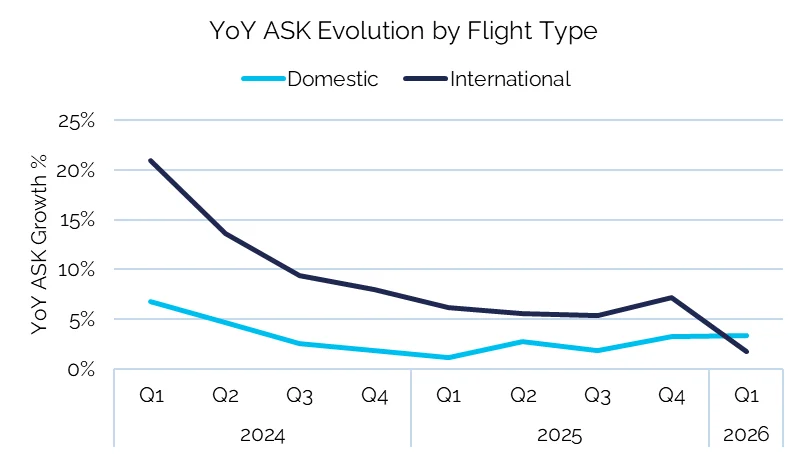
Domestic travel continued to underpin overall recovery. Domestic capacity increased by 3.3% year-on-year, compared with 1.7% growth in international markets. Compared with pre-pandemic levels, domestic capacity is now 20% higher than in 2019, while international capacity is 9.5% above the same benchmark, indicating a more gradual recovery in long-haul travel.
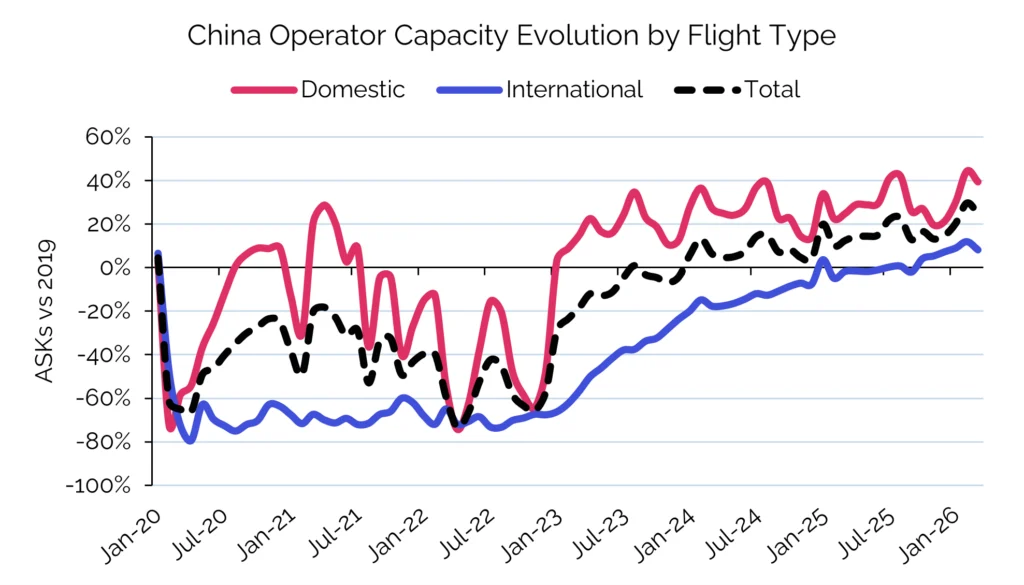
China remained a key contributor to global growth. Capacity was 9% higher than in Q1 2025 and 25% above pre-pandemic levels, supported primarily by strong domestic demand alongside a steady recovery in international services.
Aircraft supply constraints continued to limit overall capacity growth. A total of 271 aircraft were delivered during the quarter, representing a 3% decline year-on-year and a 22% drop compared with 2018 levels.
Narrowbody deliveries totalled 215 aircraft in Q1, down 5% year-on-year. Monthly production of the Airbus A320neo family averaged 27 aircraft during the quarter, compared with 38 aircraft per month for the Boeing 737 MAX.
The post Global aviation grows in Q1, despite Middle East conflict appeared first on Aviation Business News.